
You’ve invested heavily in cybersecurity measures to keep sensitive digital data from falling into the wrong hands.
But are your paper records secure?
Data breaches, identity theft, and compliance violations often begin with something simple: documents that are kept too long, discarded too soon, or thrown away without being securely destroyed. For businesses, the consequences can be costly, including regulatory penalties, lawsuits, and reputational damage.
When it’s time to dispose of sensitive paper documents, document destruction services offer a more secure alternative to the trash can or small shredder under your desk.
Managing document retention while staying compliant with data privacy laws can feel overwhelming. That’s where a clear framework helps. Let’s explore what paper documents must be retained, when they can be destroyed, and how paper shredding services play a critical role in protecting sensitive information.
Understanding which laws apply to your organization is the foundation of compliant document management. Several federal and state regulations directly affect how paper records must be handled and destroyed.
HIPAA applies to healthcare providers, insurers, and their business associates. It requires safeguards for protected health information (PHI) in all forms, including paper records. HIPAA requires covered entities to implement reasonable safeguards to protect PHI during disposal once retention requirements are met.
FACTA (Fair and Accurate Credit Transactions Act)
FACTA mandates that businesses properly destroy consumer information derived from credit reports. This law explicitly ties compliance to secure document disposal, making secure document destruction services essential for businesses that handle financial or credit-related data.
Depending on your industry, regulations like the Gramm-Leach-Bliley Act (GLBA) for financial institutions or sector-specific retention requirements may apply. Even without a formal federal mandate, secure destruction of expired records protects against identity theft, fraud, and regulatory scrutiny.
Important note: State laws vary and may impose additional recordkeeping or privacy obligations. Businesses should review local regulations and implement a retention and destruction policy that aligns with both federal and state requirements.
Document retention laws exist to protect businesses as much as they protect individuals. Certain records must be kept to support tax filings, employment decisions, legal claims, and regulatory compliance. At the same time, holding documents longer than necessary increases the risk of data exposure.
The key is understanding which documents require long-term retention, which have defined timelines, and when secure document destruction services should be used once those timelines expire.
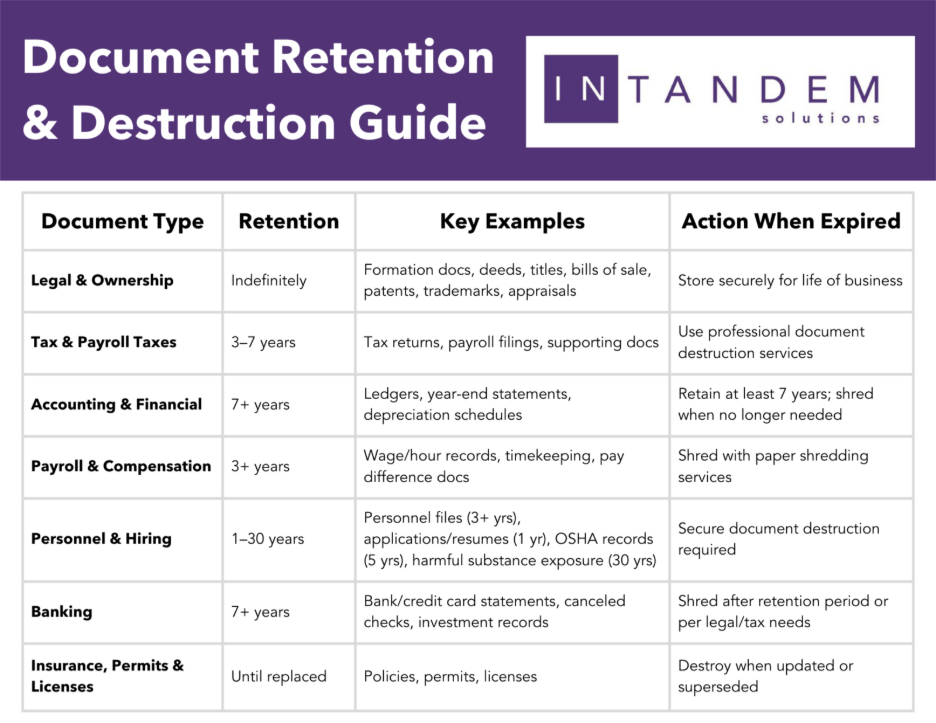
Below are general guidelines commonly used by businesses. Actual requirements may vary by industry and jurisdiction.
Keep indefinitely
These documents establish legal standing or ownership and should not be destroyed:
Store securely for the life of the business.
Keep 3–7 years
Most federal tax records should be retained for three to seven years, depending on circumstances. Many businesses keep them for seven years to reduce audit risk.
Includes:
Once retention ends, use professional document destruction services to eliminate outdated records.
Keep at least 7 years
Retain accounting records that support tax filings, including:
Some businesses retain select records longer based on CPA guidance.
Keep at least 3 years
Under the FLSA, employers must retain:
Because these contain sensitive data, paper shredding services should be used once retention periods expire.
Keep 1–30 years, depending on type
Retention varies by document:
Secure document destruction services are critical due to the sensitivity of employee information.
Keep at least 7 years
Includes:
Retention may extend based on tax or legal needs, like supporting ongoing legal claims or long-term tax audits.
Keep until replaced
Retain all policies, permits, and licenses until updated or superseded.
Once documents have met their required retention periods, keeping them longer than necessary increases the risk of:
Professional document destruction services ensure expired records are destroyed in a way that prevents reconstruction or unauthorized access.
Improper disposal, such as tossing documents into the trash, recycling bins, or relying on small office shredders, leaves businesses vulnerable. By integrating secure document destruction with retention policies, organizations:
There’s no one-size-fits-all answer. Some businesses benefit from a one-time purge, while others require recurring shredding services to stay compliant and reduce risk.
Here are some general guidelines:
Professional guidance from your paper shredding services provider can help align the schedule with your retention policies, industry regulations, and operational needs.
Professional document destruction services protect businesses throughout the entire disposal process.
Key features include:
Businesses can choose on-site shredding (documents destroyed at your location) or off-site shredding (often more cost-effective for large volumes). In both cases, strict security protocols ensure data is protected.
Many shredding providers also recycle shredded paper, supporting sustainability goals while safeguarding sensitive information.
An effective document management program doesn’t need to be complicated. A clear, repeatable plan helps ensure compliance while reducing risk.
Simple tools, like a visual cheat sheet, can help teams follow procedures consistently. Record retention policies should also be reviewed periodically to reflect changes in regulations or business operations.
Integrating recurring document destruction services ensures expired records don’t linger and create unnecessary exposure.
Not all shredding services offer the same level of protection. When evaluating providers, businesses should look for:
A trusted partner helps reduce risk and simplify compliance through consistent, reliable service.
Retention and storage are only part of the compliance equation. Secure disposal completes the lifecycle of sensitive information. By understanding applicable laws and partnering with professional document destruction services, businesses can confidently protect private information, reduce liability, and maintain trust.
Whether you need a one-time purge or ongoing paper shredding services, taking action now can prevent costly problems down the road.
Don’t let outdated records put your business at risk. Contact Intandem Solutions today to learn more about professional paper shredding services.
This article is provided for informational purposes only and does not constitute legal advice. Laws and retention requirements may vary based on industry, jurisdiction, and specific business circumstances. Businesses should consult with legal counsel or compliance professionals to determine applicable obligations before establishing document retention or destruction policies.